DESCRIPTION
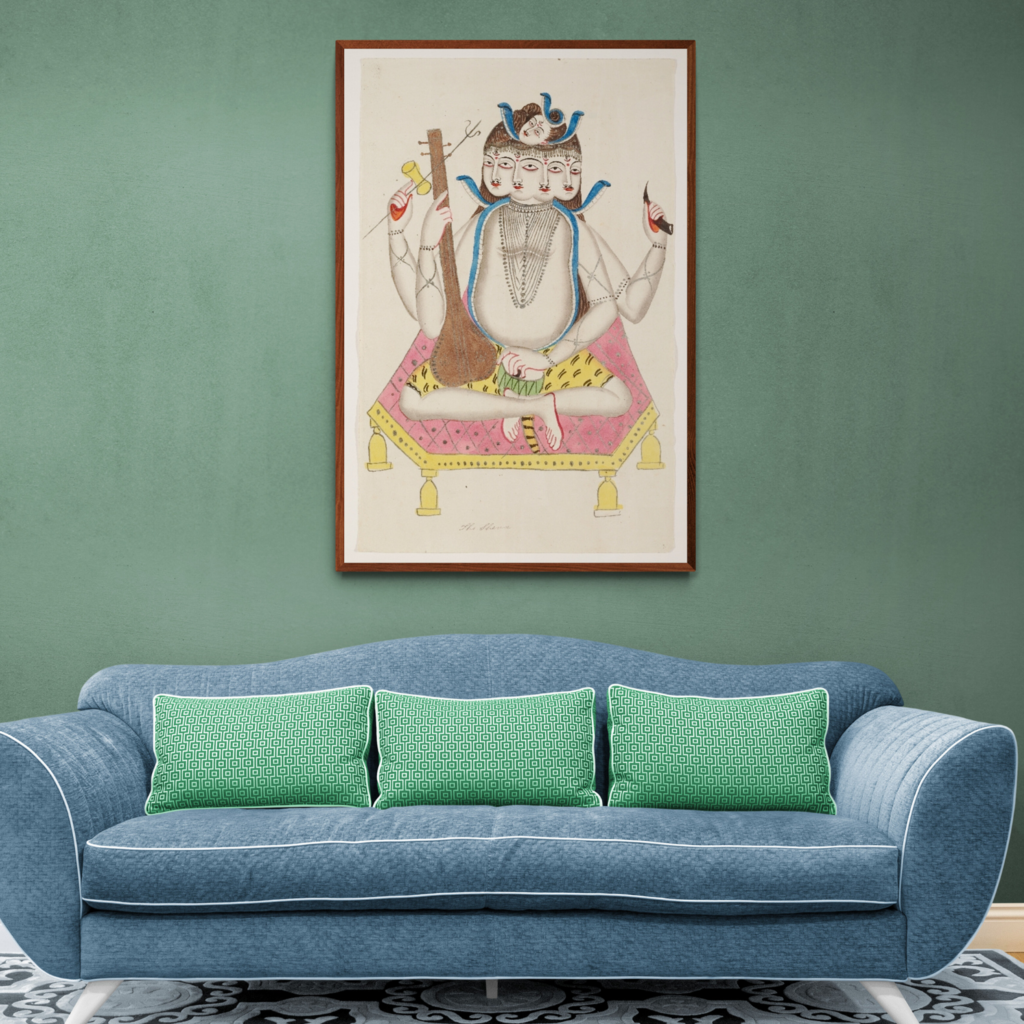
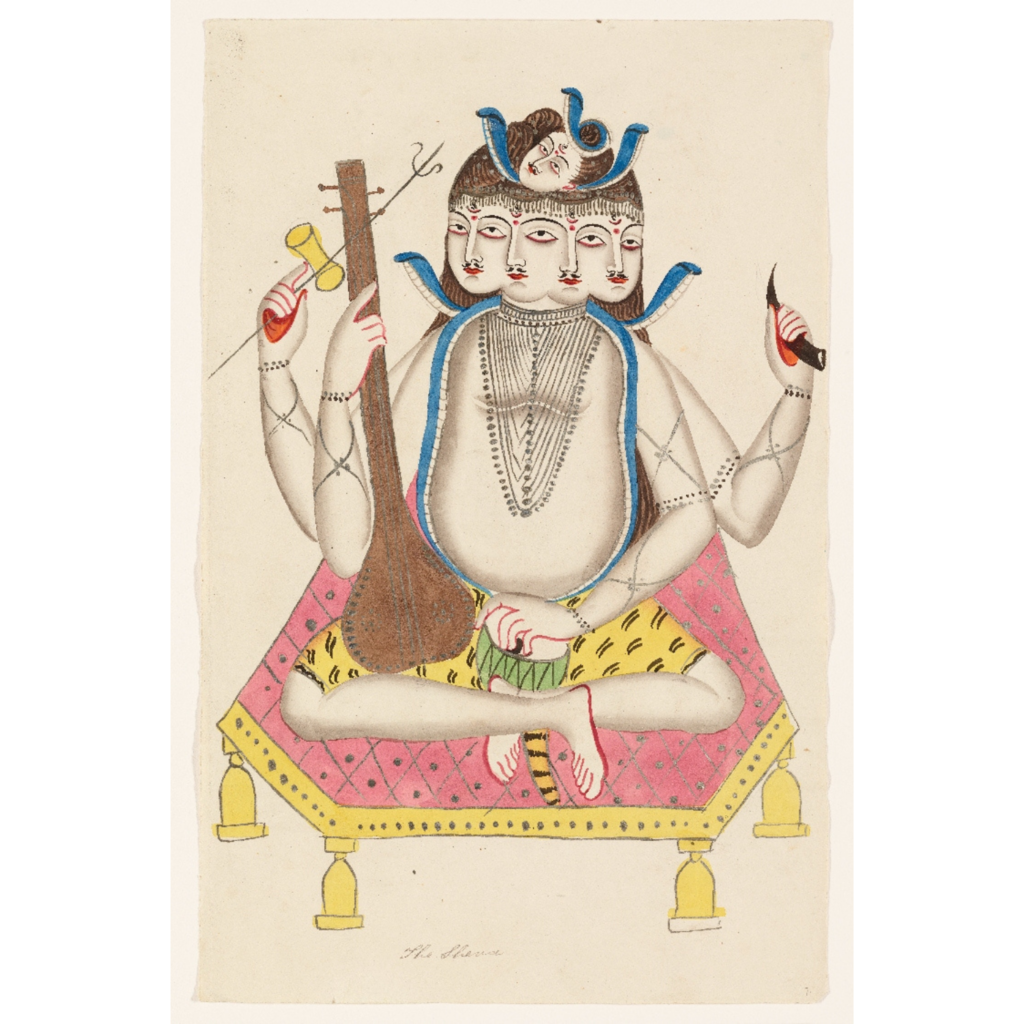
The traditional elements, directions, five senses, and five body parts are all represented by Shiva's five faces. Shiva has five forms: Sadyojata, Vamadeva, Aghora, Tatpurusha, and Ishana. Shiva, the multi-armed deity, is sitting on a chair, holding a veena in his first right hand and a damru and a trident in his second. The left hand is holding a horn, while the additional hand is playing tabla. Shiva is seated on a table, wearing a tiger skin and snake garland. There are four faces visible, with a fifth on top.
| GST |
5% |
| Color |
Black Frame |
| MediumType: |
Paper |
| Mount: |
Black Mount |
| Variable: |
Acrylic |
Dispatch within:
48 hours
Artist Name
Unknown
Width
300 mm - 11.81 inches
Height
456 mm - 17.95 inches
Medium
Original : Water Colour on Paper
Edition
Open Edition
Specifications
This is a high-quality fine art reproduction of original rare vintage painting, printed on enhanced matte archival paper with archival inks.
The frames used are high quality synthetic wood box frames or Aluminium frames. The print is protected with either 2.00 mm float glass or acrylic sheet as selected. To make it sturdy, a special board is used for the rear panel and hangers are included on the rear panel.
About the Art form
Kalighat painting, an entirely distinct genre of Indian painting that emerged in the 19th century in Kolkata (formerly Calcutta), West Bengal, is characterized by its vibrant colours and sharp contours.
The portrayal of gods and other mythical people in these paintings evolved over time to reflect a variety of topics. These mediocre pieces of art were created by Kalighat patuas (painters) to make a living by selling to a large audience.
As Kolkata grew into a bustling and successful industrial port city, migrants began to arrive in search of better prospects. Among them were numerous artists, crafters, and painters from across India, including patuas, members of a West Bengal artisan community. With its regular swarms of pilgrims, Kalighat would have been an ideal location for local artists to create and sell modest, inexpensive religious gifts.
The patuas abandoned their linear, narrative style in favour of single drawings containing one or two individuals, influenced by the various art styles surrounding them and with a desire to produce swiftly. The backgrounds were left plain, all non-essential elements were deleted, and basic colour combinations were chosen. The arrival of cheaper prepared paints and mill-made paper from Britain additionally contributed to patua productivity.
Framing
With Framing
Year
Late 19th Century